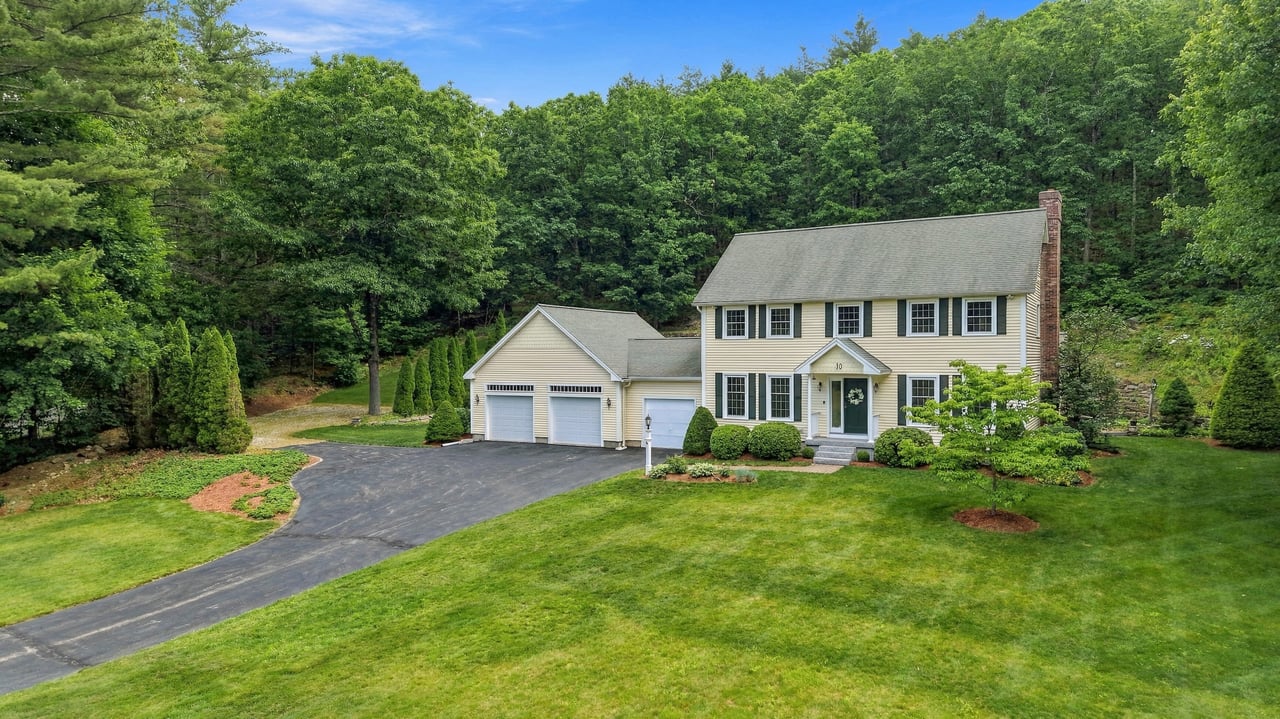
If you put Milford's 2025 property tax rate next to its neighbors', Milford looks like the most expensive town on the list. At $25.93 per $1,000 of assessed value, it was higher than Amherst, Merrimack, Brookline, and Mont Vernon. Adjusted to full market value, though, Milford's 2025 rate was $16.17. That is lower than Mont Vernon at $18.77 and Brookline at $22.18, and both of those towns look cheaper on a headline-rate list.
The gap comes from how far Milford's assessments had drifted from what homes actually sell for. This fall the town is closing that gap with its 2026 revaluation. If you are comparing towns or looking at a Milford listing right now, the two numbers you see first, the tax rate and the assessed value, are both about to change. Neither one tells you on its own what a Milford home costs to carry.
The trap: new assessments times the old rate
The most common mistake this season is easy to make. You see a 2026 assessment that is much higher than the 2025 figure, you multiply it by $25.93, and the tax bill you get looks alarming.
Whitney Consulting Group is the firm handling Milford's revaluation. In its August update to the Milford Select Board, it warned taxpayers not to apply the current tax rate to the new assessed values, according to a Citizen Portal summary of that meeting. The old rate was set to raise the town's budget from a base of about $2.1 billion in assessed value. Once that base gets bigger, the same dollars spread across more value, and the rate per $1,000 goes down. How far it drops depends on budgets that the revaluation doesn't control. The mechanics only push one way, though.
Windham went through its own revaluation in 2025, and its notice to residents made the same point. The town said the tax burden was not increased by the reassessment itself. A revaluation changes how the tax burden is divided among properties. It does not set how much the town spends.
Why Milford's headline rate has been misleading
Every year, the New Hampshire Department of Revenue Administration compares each town's assessed values with actual sale prices. The result is called the equalization ratio. Milford's 2025 ratio was 62.8%, meaning assessments averaged roughly 63 cents for every dollar of market value. When assessments run that low, the town needs a higher rate to raise the same money. A high nominal rate on a low assessment can produce the same bill as a low rate on a full one.
DRA corrects for this with a "full value tax rate," which is the rate a town would have if every property were assessed at market value. Here is how Milford compared with nearby towns for tax year 2025, ranked from lowest equalized rate to highest:
| Town | 2025 local tax rate per $1,000 | 2025 equalization ratio | 2025 full value tax rate per $1,000 |
|---|---|---|---|
| Windham | $14.15 | 96.4% | $13.55 |
| Bedford | $16.49 | 86.4% | $14.20 |
| Nashua | $16.83 | 89.0% | $14.65 |
| Merrimack | $22.11 | 67.0% | $14.70 |
| Hollis | $18.90 | 80.0% | $15.01 |
| Amherst | $23.98 | 66.2% | $15.73 |
| Milford | $25.93 | 62.8% | $16.17 |
| Mont Vernon | $21.04 | 89.8% | $18.77 |
| Brookline | $24.64 | 91.2% | $22.18 |
The source is DRA's 2025 Comparison of Full Value Tax Rates, and the ratios also appear in its 2025 Equalization Ratio Report.
Look at the towns where the two rate columns are far apart. Merrimack, Amherst, and Milford all had ratios in the 60s, so their headline rates sat well above their full value rates. Brookline and Mont Vernon had ratios near 90%, so their headline rates were close to what owners actually paid relative to market value. The local rate column sorts these towns in one order and the full value column sorts them in another. If you are deciding between two towns, the full value rate is the closer comparison.
What Milford's revaluation has shown so far
Milford's Assessing Department page says that in 2026 the town is updating all property values, as state law requires every five years under RSA 75:8-a. Here is how the process has gone, based on Whitney Consulting's updates to the Select Board as summarized by Citizen Portal:
- August 2026: Field inspections and measurements were substantially complete. Notices were expected around September 14, with informal hearings planned for September 23–25 and September 28–30.
- Late September 2026: Preliminary notices had gone out, 82 informal hearings were scheduled, and more appointments were open through October 8.
- End of October 2026: This was the target for submitting the MS-1, the valuation report DRA requires, after the firm reviewed the hearings and taxpayer responses.
The key figure came at the late-September Select Board meeting. Steve Hamilton of Whitney Consulting reported that Milford's preliminary 2026 taxable value was about $3.14 billion, up roughly 48.3% from about $2.1 billion in 2025, according to Citizen Portal's account.
That figure fits the state's numbers. DRA's 2025 report estimated Milford's equalized valuation at $3,356,141,396 against a local assessed base of $2,100,018,718. The revaluation is moving Milford's assessments much of the way toward the market value DRA had already measured. Since the base is growing by close to half, the 2026 headline rate will be calculated on a very different footing from $25.93.
Keep in mind that 48.3% is a townwide total, and the $3.14 billion was still preliminary as of the late-September update. Individual properties will not all rise by the same percentage, because a revaluation corrects the parts of town where assessments had fallen furthest behind. Whether your own share of the tax burden goes up or down depends on how your new assessment compares with that townwide change.
What is still pending as Milford heads into November
As of DRA's October 16 report of completed 2026 tax rates, Milford was not on the list. That means no 2026 Milford rate had been set by then. Milford's Tax Collection page shows that the first 2026 installment was due July 1. The second bill is the one that will reflect the new values and the new rate.
For buyers, this creates a short window where listing information can be out of date. A Milford listing may still show a 2025 assessment and a 2025 tax figure, both based on values around 63% of market. Those numbers will change once the 2026 rate is set. Neither 2025 figure tells you what your carrying cost will be next year. Better reference points are the new 2026 assessment and DRA's full value rate.
For owners who disagree with their final assessment, the state's process starts at the town. The New Hampshire Board of Tax and Land Appeals explains that an abatement application is filed with the municipality first. If the tax notice is mailed by December 31, the deadline is March 1. If it is mailed later, the deadline is two months after the notice. RSA 76:16 also says the municipality must decide by July 1, and that no response by then counts as a denial. When Milford mails its final 2026 bill will determine which deadline applies.
A few quick questions
Did Milford's taxes go up because of the revaluation? The revaluation changes assessed values. The total amount the town raises comes from budgets, and DRA had not set Milford's 2026 rate as of its October 16 report.
Are other nearby towns likely to see the same pattern? Amherst at 66.2% and Merrimack at 67.0% had 2025 equalization ratios close to Milford's, so their headline rates were also well above their full value rates. When any town with a low ratio revalues, the same mechanics apply.
Which number should I use to compare towns? DRA's full value tax rate puts every town on the same market-value footing, so it is the fairest single number for comparing towns.
This post is general information, not legal, tax, or financial advice. Please confirm the details of your own property and tax situation with the town assessing office or a qualified professional.
If you are weighing a Milford home this fall, or wondering how a new assessment affects your plans to sell, I'm happy to go through the numbers on a specific property with you and explain what has changed since 2025. Sharon Bean is here when you're ready. Let's Connect.